
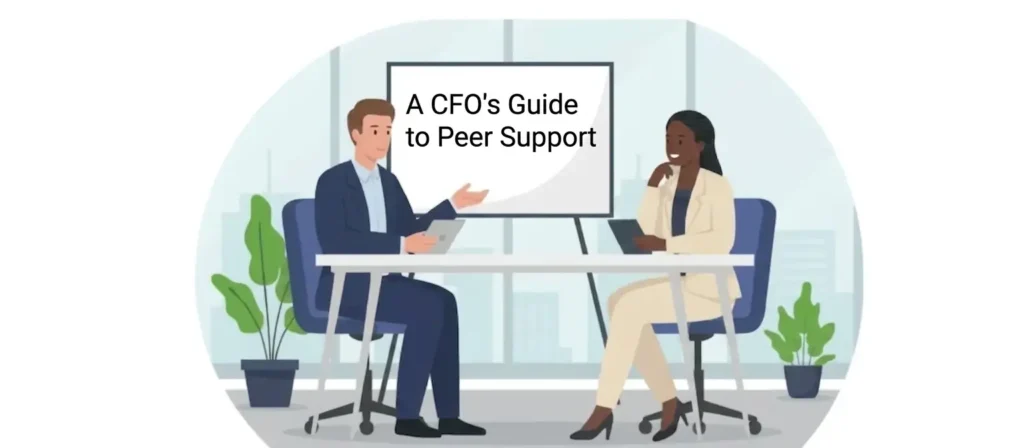
There are huge opportunities for CFOs, and those on a CFO career path, to accelerate their career journeys through peer support. Whilst CFOs have responsibilities for a wide range of topics, from deployments of AI to shaping unit economics, there will always be another finance leader who’s able to share important input on challenges you face. In many respects the only hurdles to taking advantage of these peer-to-peer opportunities are identifying a true peer, finding the time to network and conducting your dialogues with openness.
Get matched with a peer
Finding someone who is truly your peer isn’t always easy. If you are a CFO in a high-growth scale-up it might need to be another finance leader in a similar revenue bracket, or at least someone who recently took their business through that stage. In addition, some of the playbooks that CFOs deploy in helping to shape predictable and sustainable growth are specific to the vertical you are in. For certain, SaaS CFOs will get more from time spent with another person also focused on building SaaS businesses. Similarly, marketplace businesses or deep tech businesses have completely different levers to exploit on the growth journey. This is one of the reasons so many leading Tech CFOs join communities, like Startup CFO. That capability to be brought together with other finance leaders at similar stages and in similar businesses is hugely valuable.
Reciprocity in CFO peer support
Now you’ve identified suitable peers it’s important that you set the scene for the conversations to be authentic and allow for candid discussions on some of the most important topics. Keeping it informal is key. That’s why CFOs have been catching up over a beer for a long time before anyone coined the term ‘community’ for professional peer groups. The second lesson is one about reciprocity. It’s easy to imagine that the things you are going through are going to be the subject of the peer discussions. But in reality everyone is going through something and you need to keep in mind that giving back as much as you receive is critical. If you find you are diving into a peer relationship and little value exchange seems to be returned to the other side, then what you are really engaged in is mentoring.
Be open to vulnerability
The third thing to bring into the formula to make significant gains through peer relationships is vulnerability. It seems to be a phrase in modern parlance that is doing a lot of heavy lifting, but ‘being vulnerable’ fundamentally means allowing yourself to be open about gaps you might have in your experience or skillset. The breadth of things a CFO goes through is significant, with many senior finance leaders also owning People and Talent, Legal and Regulatory and IT support. It’s impossible to be an expert in all of these things, or to have experienced everything that a CFO would experience taking a business from Startup to Scaleup stage, or beyond. Acknowledging those gaps openly with a trusted peer is where some of the most valuable conversations begin.
Cadence matters
If you’ve found your person and got together, perhaps over a coffee or a beer, or even at a community event, then you’ve got the ball rolling. You have set yourself up to have a place to take some of the more challenging things you might face, as well as discussing some of the inevitable stresses and strains. Now you’ll need to ensure there is a regular cadence. To really build that relationship into one of trust and peer support you’ll need to find a way to get together regularly. Sometimes it can be helpful to find a shared hobby — meeting for a lunchtime run, perhaps a passion for checking out the latest breakfast venues in your city. This will allow you to discover another anchor to bring you together for in-person discussions on challenges in your role as a CFO.
Identify a suitable setting
This in many ways brings us to the topic of where to meet. Realistically, video calls can be effective for a regular get together, but they don’t quite cut the mustard when it comes to relationship building. The second point to make on the setting is to consider whether the venue selected is really a neutral one. If your accounting firm is hosting a dinner or a platform provider is running an event, it can seem like a free night out — but those events are conducted on the provider’s terms and might not give you the setting for a really candid conversation free of distractions.
Mastermind groups for CFOs
The absolute gold standard for CFOs focused on peer-enhanced problem solving is mastermind groups. This is the format of choice of many Founders, and that should be no surprise given the effectiveness. A mastermind group is a peer group, typically anywhere between six and twenty individuals all in similar careers.
The active ingredients of a really high-performing mastermind group are curation and moderation. As referenced earlier, matching people to their peers brings a power. And that power to discuss and work through challenges in a confidential setting is magnified by expert moderation. In any group dialogue there are some people who will dominate the airtime, some who contribute a bit and those who sit on the sidelines unless spurred into action. The value-add in the moderation is twofold. Just by having that person present, those who typically are first to dive in tend to concisely apply the brakes, aware that elegant contributions don’t need to be curtailed or nudged towards brevity. Secondly, expert moderation opens up space for those who are not always the first to dive in to contribute. The balanced conversations that result are ideal for problem solving, and CFOs who join mastermind groups, such as those run by the Startup CFO community, report back that they are highly impactful and truly a place for cathartic release.
Transitioning to mentoring
The point to finish on should really be about the journey, and what all of this means when you arrive at the destination. Leading CFOs battle through all the struggles of any business leader. When their careers take off they are likely to take on more senior roles, deliver exits or IPOs and perhaps even graduate into the CEO seat. So if peer support helps you arrive at your destination, don’t forget to give something back. Demand for mentoring among CFOs is high and there are probably some really talented people on that career path who have been in your team over the years. Volunteer for it, pay it forward and keep the cycle going. A thriving peer network isn’t just built by those who draw from it — it’s sustained by those who give back.


